
Faw Qibli (Pbow)
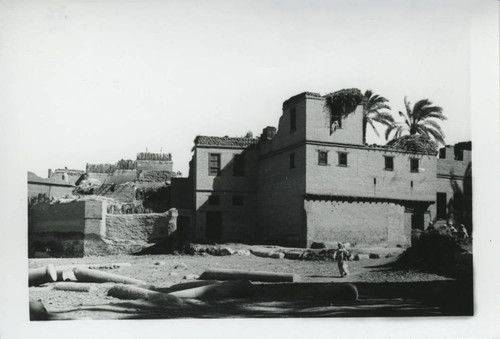
The ruins of the great basilica of Pbow, chief monastery of St Pachomius, founder of communal monastic life — near where the Nag Hammadi codices were found.
The monastery of Pachomius
Faw Qibli, a village near Nag Hammadi in Qena Governorate, is the site of ancient Pbow, the chief monastery of St Pachomius (c. 292–348). Pachomius, a former soldier who converted to Christianity, is regarded as the founder of cenobitic, or communal, monasticism: unlike the hermits of the desert, his monks lived together in organised communities under a written rule, sharing work, meals and prayer. His rule influenced later monastic rules in both East and West, including that of St Benedict. Pbow became the centre of a federation of Pachomian monasteries in Upper Egypt, with thousands of monks.
The basilica
The site preserves the remains of a great basilica built in the fifth century, one of the largest churches of late antique Egypt, with granite columns lying among the ruins. It was excavated in the second half of the twentieth century by an expedition associated with the Institute for Antiquity and Christianity in California. Little survives above ground, but the scale of the foundations conveys the importance of the monastery.
The Nag Hammadi library
In 1945, at the foot of the cliffs of Gebel al-Tarif near Nag Hammadi, not far from Pbow, local farmers discovered a jar containing thirteen papyrus codices in Coptic — the Nag Hammadi library — including Gnostic texts such as the Gospel of Thomas. Some scholars have suggested that the codices may have come from a Pachomian monastery, hidden when such texts were condemned. Access to the site of Faw Qibli should be confirmed in advance.
Exhibo editorial
There is not much to see at Faw Qibli — granite columns lying in a field, foundations of a vast basilica — but it is one of the most important places in the history of Christianity. Here Pachomius organised the first monasteries where monks lived together under a common rule, a model that would spread across the whole Christian world.
Come for the story, not the spectacle, ideally combined with the Prince Youssef Kamal Palace in Nag Hammadi. And remember that a few kilometres away, in 1945, farmers digging for fertiliser found the Nag Hammadi codices, changing our understanding of early Christianity.
How to find it
Faw Qibli lies on the east bank of the Nile near Nag Hammadi, reached by car; ask locally for the ruins of the Pachomian basilica. A guide familiar with the area is recommended.