
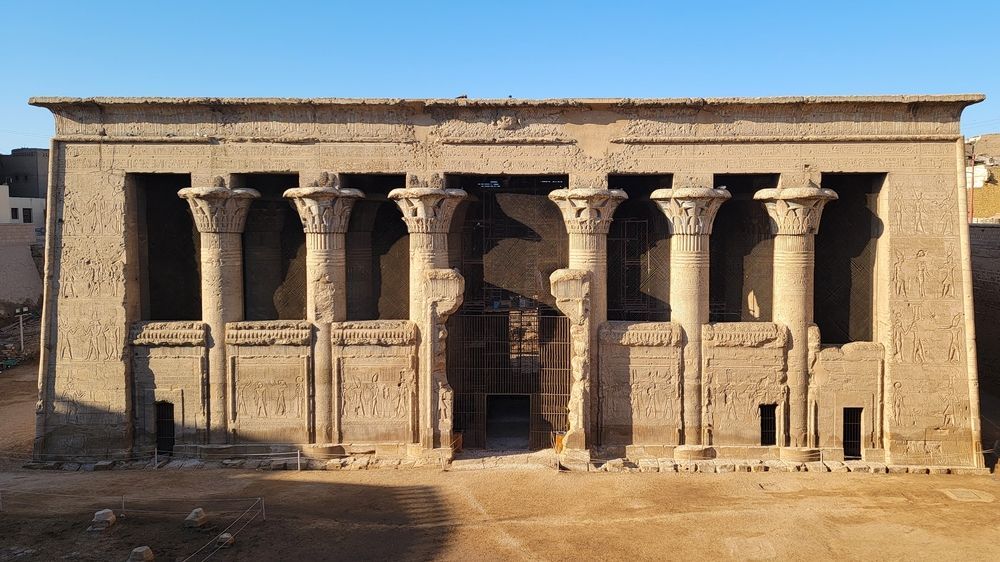
Temple of Khnum at Esna
A Roman-era temple hall nine metres below the modern town — its astronomical ceiling newly revealed in vivid reds and yellows.
A temple in a pit
The Temple of Khnum stands in the middle of the town of Esna, on the west bank of the Nile about 55 kilometres south of Luxor. Because the modern town has grown up around it over the centuries, the temple lies some nine metres below today's street level, and visitors descend a staircase to reach it. Khnum, the ram-headed god, was believed to shape human beings on his potter's wheel and to control the Nile flood; at Esna he was worshipped with the goddesses Neith and Menhyt. Of the great temple that once stood here, only the pronaos — the monumental columned hall at the front — survives, but it is one of the finest of its kind.
A Roman hall
The pronaos was built and decorated in the Roman period, between the first and third centuries AD, under emperors from Claudius to Decius, whose names appear in its cartouches as pharaohs. Its roof rests on twenty-four columns with richly carved capitals in varied floral forms. The walls and columns are covered with inscriptions and offering scenes that describe the cult of Esna's gods in more detail than almost any other temple in Egypt, including hymns, festival calendars and creation myths; they were documented by the French Egyptologist Serge Sauneron between the 1950s and 1970s.
Colours regained
For nearly two thousand years, the hall was blackened by soot from fires lit inside it, along with dust, bird and bat droppings and salts. Since 2018, a joint project of the Egyptian Ministry of Tourism and Antiquities and the University of Tübingen, led by Hisham El-Leithy and Christian Leitz, with a team of up to thirty Egyptian restorers, has been cleaning the surfaces. The work, completed for the ceiling in 2023 and continuing on the walls, has revealed the original colours of the astronomical ceiling — signs of the zodiac, constellations, planets, decans and the vulture and serpent goddesses Nekhbet and Wadjet — and of the columns, together with previously unrecorded inscriptions. Unlike Dendera, where blue and white dominate, Esna's palette is mostly yellow and red. With Dendera, Esna now has one of the two best-preserved astronomical temple ceilings in Egypt.
Exhibo editorial
You walk down a flight of steps from a busy market street into a pit, and suddenly you are inside a forest of columns, looking up at a ceiling that until a few years ago was black. Now it blazes in red, ochre and gold: winged lions, a celestial archer, stars, vultures with outspread wings, the zodiac wheeling overhead. It is one of the great restoration stories of our time.
Most Nile cruises stop here only briefly, and many travellers skip it altogether. Don't. Go when the morning light filters in, crane your neck, and look for the details the cleaners found with toothpicks — clothing, crowns, faces that nobody alive had seen in colour before.
How to find it
Esna lies about 55 km south of Luxor on the west bank of the Nile; the temple is in the town centre, a short walk from the Nile cruise landing through the covered market street. The ticket office is at street level; a staircase leads down into the sunken temple hall.