
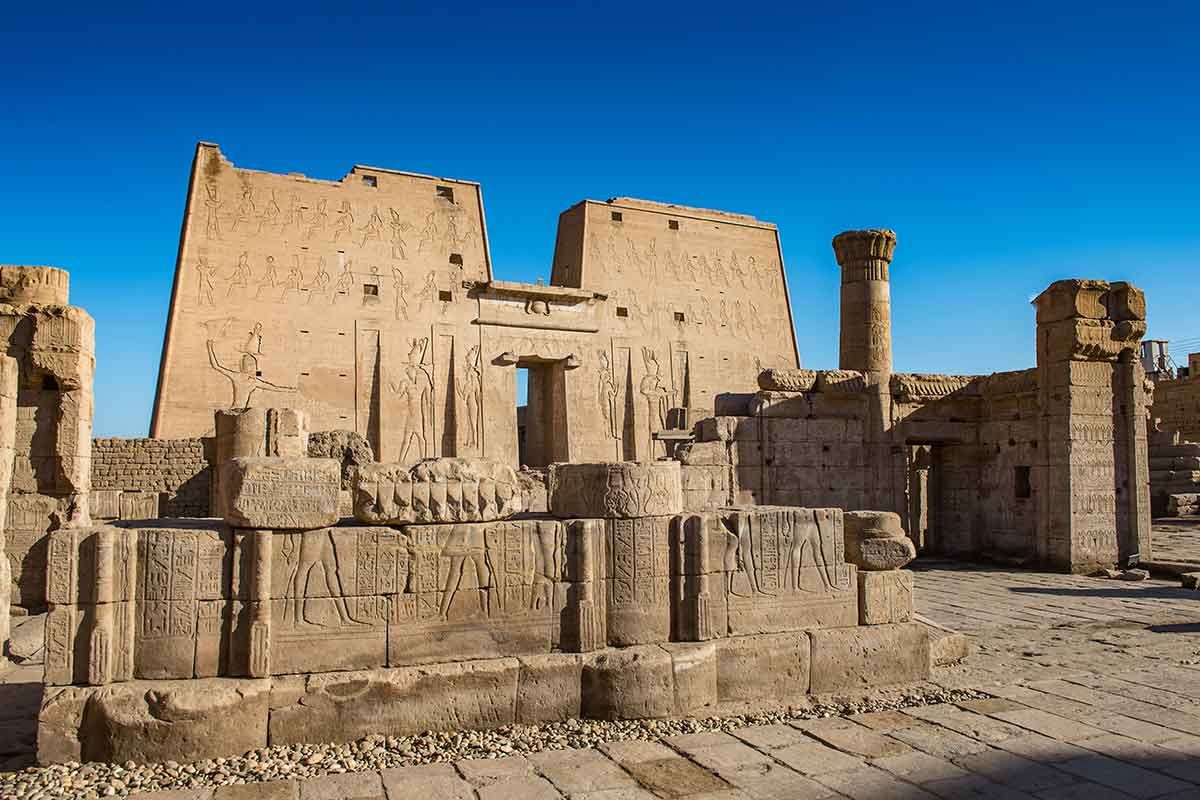
Temple of Horus at Edfu
The best-preserved temple in Egypt — a complete Ptolemaic sanctuary of the falcon god, from pylon to holy of holies.
The temple of the falcon god
The Temple of Horus at Edfu, on the west bank of the Nile between Luxor and Aswan, is the most complete and best-preserved temple of ancient Egypt. Dedicated to Horus, the falcon-headed god of kingship, it was built under the Ptolemaic dynasty over almost two centuries, from 237 BC under Ptolemy III to 57 BC under Ptolemy XII, on the site of earlier temples. Because it was buried under sand and later houses for centuries, it survived almost intact, with its roof, walls and enclosure still standing; it was cleared in the 1860s by the French archaeologist Auguste Mariette.
A complete temple
Visitors can follow the full sequence of an Egyptian temple. A monumental pylon, some 36 metres high and carved with giant figures of Ptolemy XII smiting his enemies, opens onto a great colonnaded court where a pair of granite falcon statues guard the entrance to the temple proper. Beyond lie two hypostyle halls, a series of offering halls and the sanctuary, where a polished granite naos once held the god's statue and a replica of his sacred barque stands today, surrounded by chapels.
Texts in stone
The walls of Edfu are covered with inscriptions that make it one of the most important sources for Egyptian religion: building texts describing the temple's foundation and dimensions, ritual calendars, and long mythological texts. Along the inner enclosure wall, a series of reliefs recounts the conflict between Horus and his uncle Seth, shown as a hippopotamus, a drama that was re-enacted during the temple's festivals. Each year the statue of Hathor of Dendera travelled upriver to visit Horus at Edfu for the festival of their sacred marriage.
Visiting
Edfu is a regular stop on Nile cruises between Luxor and Aswan, and can be crowded in the middle of the day; early morning or late afternoon visits are quieter.
Exhibo editorial
If you want to understand how an Egyptian temple worked, come to Edfu: everything is still here, roof and all, exactly in order. You pass through the great pylon, past the granite falcon in his double crown, into ever darker halls, until you reach the sanctuary with its black granite shrine — and feel how the light was choreographed to make the god's home more mysterious at every step.
Take time in the corridor between the temple and the outer wall, where Horus fights Seth in relief after relief, harpooning the hippopotamus. Go early, before the cruise ships land, and the temple feels almost as it did when the priests walked its halls.
How to find it
Edfu lies about 110 km south of Luxor and 105 km north of Aswan; the temple is in the town, a short drive or horse-carriage ride from the Nile cruise landing. From the visitor centre, walk to the great pylon; the falcon statues stand at the entrance to the hypostyle hall at the far side of the court, and the Horus and Seth reliefs line the corridor running around the temple inside the enclosure wall.