Meidum Pyramid
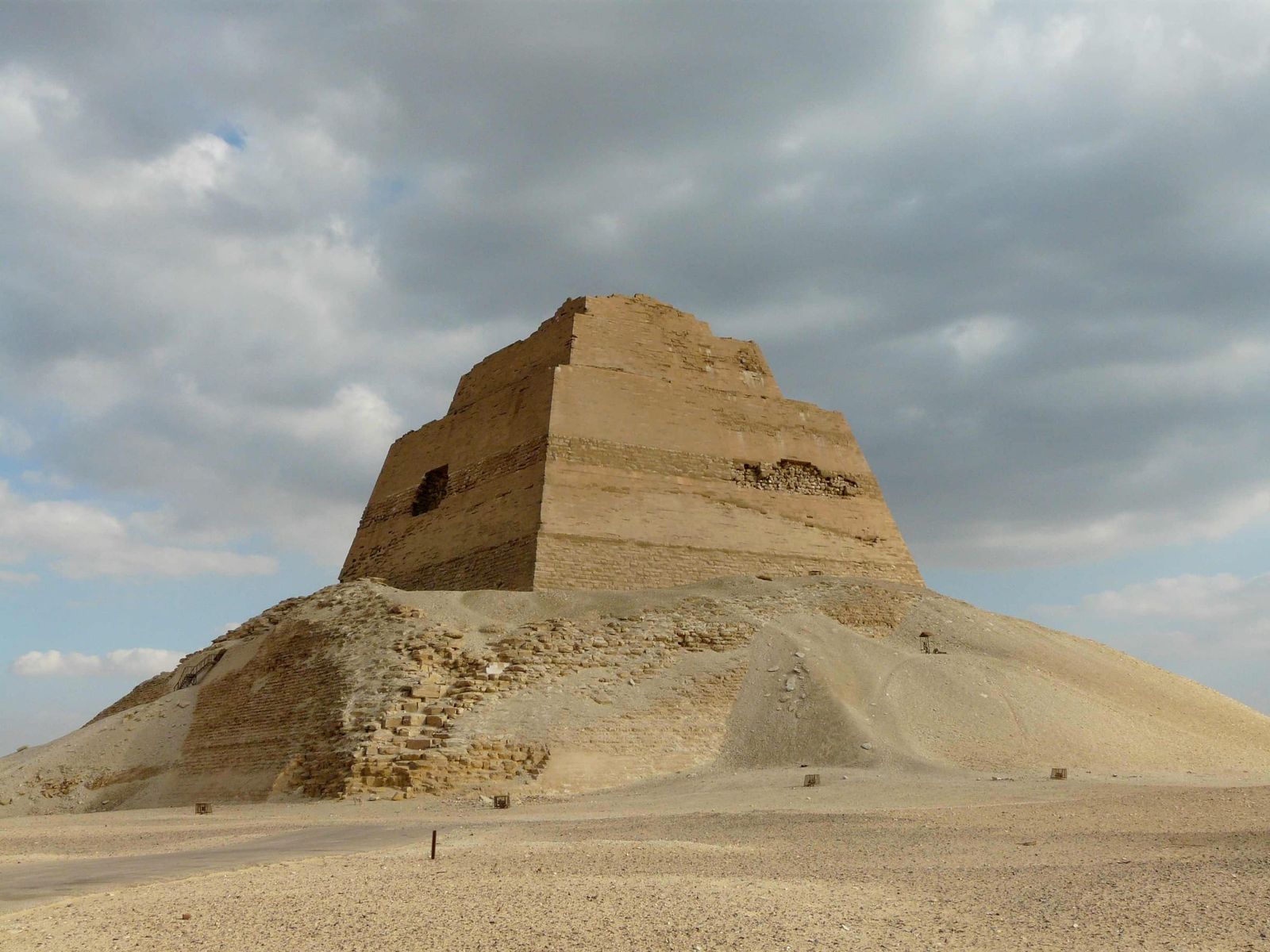
The 'collapsed pyramid' of the Fourth Dynasty — a towering stepped core rising from rubble, where the true pyramid was born.
A pyramid in transition
The pyramid of Meidum stands alone on the desert edge about 100 kilometres south of Cairo, near the entrance to the Fayoum, in Beni Suef Governorate. It is one of the key monuments in the evolution of the pyramid. Begun as a step pyramid at the end of the Third Dynasty — possibly under King Huni — it was completed and transformed by Sneferu, first king of the Fourth Dynasty, who filled in its steps to create a smooth-sided pyramid, before building his two great pyramids at Dahshur. At some point, its outer casing and the outer layers collapsed, leaving the tall stepped core that gives the monument its strange, tower-like silhouette rising from a mound of debris; when the collapse happened is still debated.
Inside the pyramid
Visitors can enter the pyramid through a passage on the north face that descends steeply into the rock and then rises to a small burial chamber with a corbelled roof — one of the earliest corbelled chambers in Egypt, a technique that would culminate in the Grand Gallery of the Great Pyramid. No sarcophagus or burial was found inside. On the east side of the pyramid stand the remains of a small mortuary temple and the beginning of a causeway.
The mastabas of Meidum
Around the pyramid lies a cemetery of large mud-brick mastabas of the early Fourth Dynasty. The mastaba of Nefermaat and his wife Atet yielded the famous painting of the Meidum Geese, now in the Egyptian Museum in Cairo, and the mastaba of Rahotep and Nofret the celebrated painted statues of the couple, among the masterpieces of Old Kingdom sculpture, also in Cairo.
Exhibo editorial
You see it from far away across the fields: a pale stone tower standing on a heap of sand in the desert, unlike any other pyramid in Egypt. Up close, it looks less like a ruin than an experiment — the moment Egypt's builders were learning, by trial and error, how to make a pyramid stand.
Go inside if you can manage a steep, narrow passage: the small corbelled chamber at the end is a quiet, slightly eerie place, the ancestor of the Grand Gallery at Giza. There will probably be no one else there. Meidum is an easy stop on the road from Cairo to the Fayoum, or on the way south to Middle Egypt.
How to find it
Meidum lies on the desert edge west of the Nile near El Wasta, about 1.5–2 hours by car south of Cairo and a short drive from the eastern entrance to the Fayoum. Follow the road from El Wasta towards the desert; the ticket office is at the foot of the pyramid, and the entrance to the interior is up a stairway on the north face.