
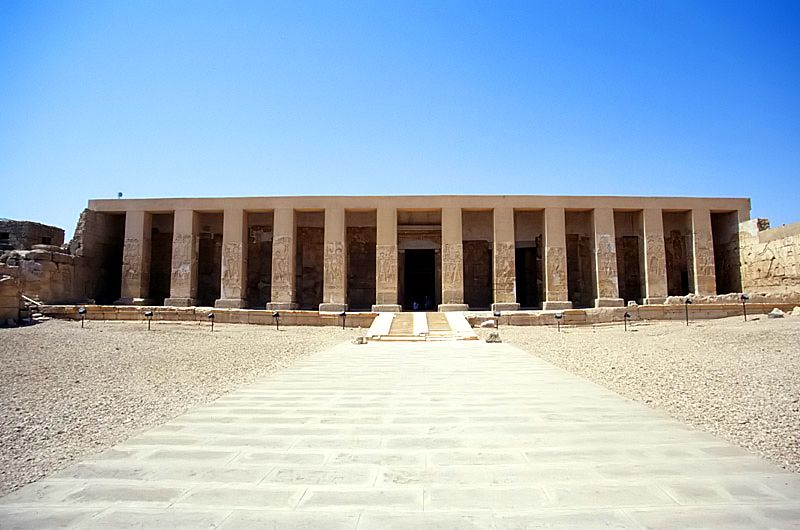
Temple of Seti I and the Osireion, Abydos
The most refined reliefs in Egypt, the Abydos King List and the mysterious Osireion — at the sacred city of Osiris.
The holy city of Osiris
Abydos, on the west bank of the Nile in Sohag Governorate, was one of the most sacred places of ancient Egypt. It was the burial ground of Egypt's first kings, at the dawn of the pharaonic state around 3000 BC, and later the cult centre of Osiris, god of the dead and of resurrection, whose head was believed to be buried here. For thousands of years, Egyptians made pilgrimage to Abydos, built chapels and set up stelae so as to share in the god's annual festival, and kings built temples and cenotaphs here.
The Temple of Seti I
The greatest of these is the temple of Seti I, built around 1290–1279 BC and completed by his son Ramesses II. Unusually, it is L-shaped and has seven sanctuaries side by side, dedicated to Osiris, Isis, Horus, Amun-Ra, Ra-Horakhty, Ptah and the deified king. Its relief carving, in fine white limestone, is widely regarded as the most beautiful in Egypt: delicate, precise, much of it still retaining its original colour. In a corridor known as the Gallery of the Kings, Seti and the young Ramesses are shown honouring a list of seventy-six of their royal predecessors, from Menes onwards — the Abydos King List, one of the most important sources for the chronology of Egyptian kings, which omits rulers such as Hatshepsut and the Amarna kings.
The Osireion
Behind the temple, at a lower level, lies the Osireion, a cenotaph for Osiris built of massive granite pillars and sandstone, designed to evoke the primeval mound rising from the waters of creation; groundwater now floods its central hall, adding to its mystery. Its architecture is so different from the temple that it was long the subject of speculation, but inscriptions and its integration into Seti's complex date it to his reign.
Around the temple
Abydos also includes the temple of Ramesses II, with brightly painted reliefs of the Battle of Kadesh; the Shunet el-Zebib, a huge mud-brick enclosure of the Second Dynasty king Khasekhemwy, one of the oldest standing royal buildings in the world; and Umm el-Qa'ab, the cemetery of the first kings, where one tomb was later venerated as the tomb of Osiris.
Exhibo editorial
Many people who have seen all of Egypt's temples say this is the one that stays with them, and you understand why the moment you step into the hypostyle hall. The carving is so fine it looks drawn rather than cut: gods with gentle faces, hieroglyphs crisp as type, blues and reds still glowing on the white stone. It is the high point of Egyptian relief, and it is quiet.
Find the King List and run your eye down seventy-six royal names, back to the very beginning of the Egyptian state. Then go out to the Osireion and look down into its flooded hall, granite pillars standing in green water. Abydos is a long day trip from Luxor; give it a whole morning.
How to find it
Abydos lies about 160 km north of Luxor, near the village of El-Araba el-Madfuna, a 2.5–3 hour drive; most visitors come on a day trip, often combined with Dendera. From the visitor centre, walk up to the temple façade; the Gallery of the Kings opens off the left side of the second hypostyle hall, and the Osireion is behind the temple, reached by walking round to the rear.