
Serabit el-Khadim
A mountain-top temple of Hathor, Lady of Turquoise, above ancient mines — where the earliest known alphabet was found.
The turquoise mines
Serabit el-Khadim lies on a high plateau in the mountains of south-western Sinai, inland from the coastal town of Abu Zenima. From the Middle Kingdom to the end of the New Kingdom, roughly 1900–1150 BC, Egyptian expeditions came here to mine turquoise from the surrounding hills, and their galleries can still be seen in the mountainsides. On the summit of the plateau, they built a temple dedicated to Hathor, "Lady of Turquoise", together with the god Sopdu, protector of the eastern deserts.
The temple of Hathor
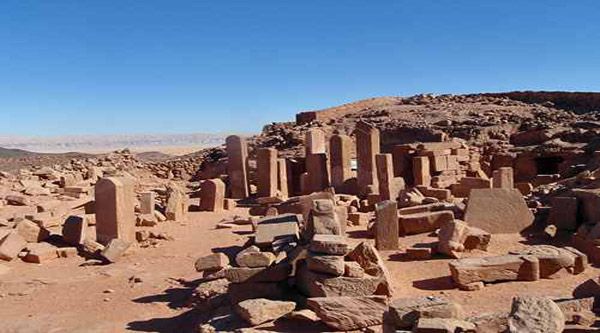
The temple grew over centuries from a rock-cut cave shrine into a long complex of courts and chapels, many of its walls now ruined. Its most striking feature is the field of standing stone stelae, set up by expedition leaders to record their missions, the pharaohs who sent them and the quantities of turquoise obtained, which rise among the ruins against the mountain sky.
The birth of the alphabet
In 1905, the British archaeologist Flinders Petrie found at Serabit el-Khadim a group of short inscriptions in an unknown script, carved on statues and on rocks near the mines. Known as the Proto-Sinaitic inscriptions and dated to the Middle or early New Kingdom, they are considered the earliest known examples of alphabetic writing: workers from the Levant adapted Egyptian hieroglyphs to write their own Semitic language with signs for sounds. This script is the ancestor of the Phoenician alphabet and, through it, of the Hebrew, Arabic, Greek and Latin alphabets.
Visiting
The site is reached by four-wheel-drive vehicle and a steep climb of about an hour on foot, with a licensed Bedouin guide; it is remote and best visited as part of a trip of one or two days.
Exhibo editorial
Getting there is an expedition — a jeep across the desert, then a stiff climb up a mountain with a Bedouin guide — and that is part of its magic. At the top, on a wind-swept plateau surrounded by peaks, stelae stand like a stone forest among the ruins of a temple to the goddess of turquoise.
And somewhere here, workers who spoke a Semitic language took Egyptian hieroglyphs and turned them into an alphabet. Every letter you are reading now descends, distantly, from those scratches. Go with a good guide, start early, and give yourself time at the summit.
How to find it
Serabit el-Khadim lies about 50 km inland from Abu Zenima on the Gulf of Suez coast. Arrange a 4x4 trip with a Bedouin guide from Abu Zenima, Dahab or Saint Catherine; from the end of the track, a steep path climbs about an hour to the plateau and the temple.