
From 22 November 2026
Napoleon's Fleet: Tales Told by the Sea
Finds from the French wrecks of Abu Qir Bay
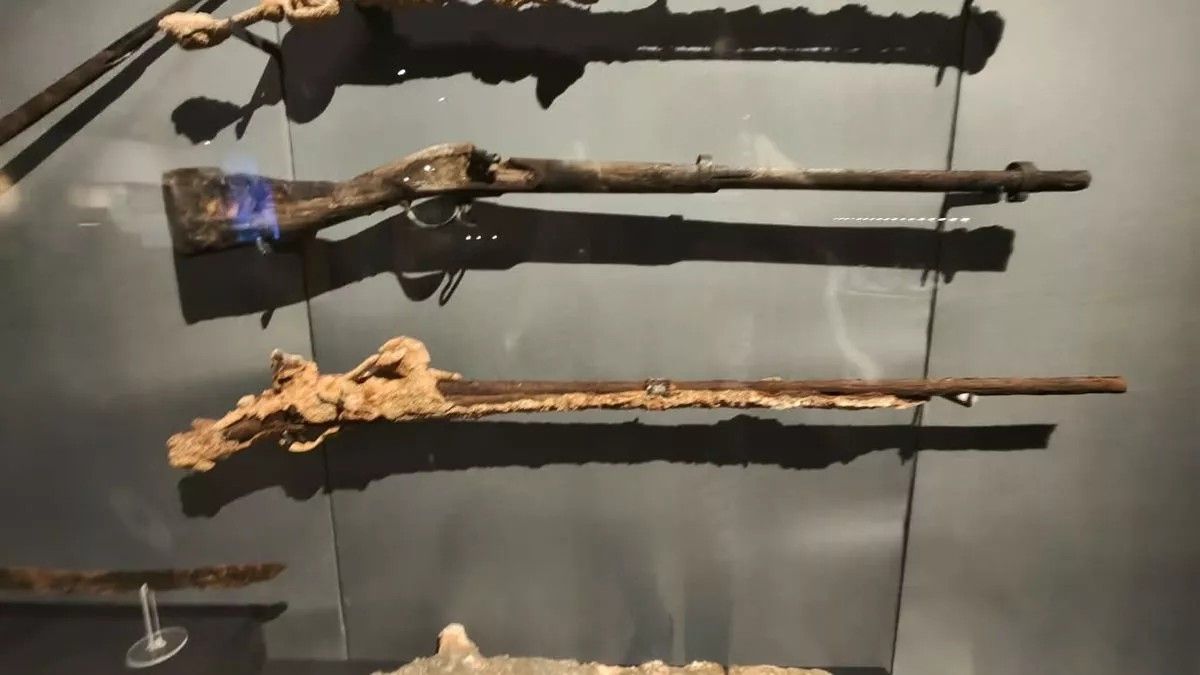
A leather shoe. Silver spoons. A set of brass weights for measuring medicine. These are the things that came up from the seabed off Egypt's northern coast, two centuries after the men who used them went down with Napoleon Bonaparte's fleet. The National Museum of Egyptian Civilization opened this exhibition on 22 November 2026 for the Day of Underwater Cultural Heritage. It also marks thirty years since Egypt set up its Department of Underwater Antiquities. The story starts in Toulon on 19 May 1798. The fleet sailed with soldiers, horses, artillery and provisions, plus scholars, engineers and artists sent to study Egypt. It took Malta on 9 June and landed troops near Alexandria at the end of the month. On 4 July the transport ship Le Patriote hit the reefs at the entrance to the Western Harbour and sank with her timber, food and medical equipment. Most of the warships then lay at anchor in Abu Qir Bay under Vice Admiral Brueys. There were 13 of them. The flagship L'Orient carried 120 guns. On 1 August Horatio Nelson found them and attacked before nightfall. Some British ships slipped between the French line and the shore while others fired from the sea side. Around ten at night L'Orient blew up. By the next day the French fleet was largely destroyed or captured. The expedition had lost its sea link with France. The show spends less time on the battle than on life aboard. There are cooking pots, oven bricks from the galleys, ceramic plates, lead and silver forks. There are brass cup weights of the kind the French called Pile de Charlemagne, used with two-pan scales by the ship's pharmacist and surgeon, alongside surgical instruments. Buttons in bone, bronze and silver carry symbols of the units that served on board. Buckles, jewellery, watches, copper hull sheathing, nails, rigging and bilge pumps fill out the picture. Muskets and daggers sit near cases of gold, silver and bronze coins from Louis XIV, Louis XV and mostly Louis XVI, with pieces from Malta, the Ottoman Empire, Venice, Spain and Portugal. The labels say some foreign coins may come from the treasure taken in Malta, then are careful to call it a possibility. The last section follows the people who found all this. The Egyptian diver Kamel Abu El-Saadat mapped wrecks and cannons in the 1950s and 1960s from tips given by local fishermen. Jacques Dumas began new work in 1983. In 1986 a mission led by Max Guérout found Le Patriote. Franck Goddio's team surveyed the bay from 1996 and excavated from 1998. The remains of L'Orient are spread over more than half a square kilometre. Six or seven French ships still lie in the bay.
Tickets
Included with museum admission
Check the museum profile for general admission details.