
Paris · 30/09/2026
Günther Uecker: Verletztes Feld
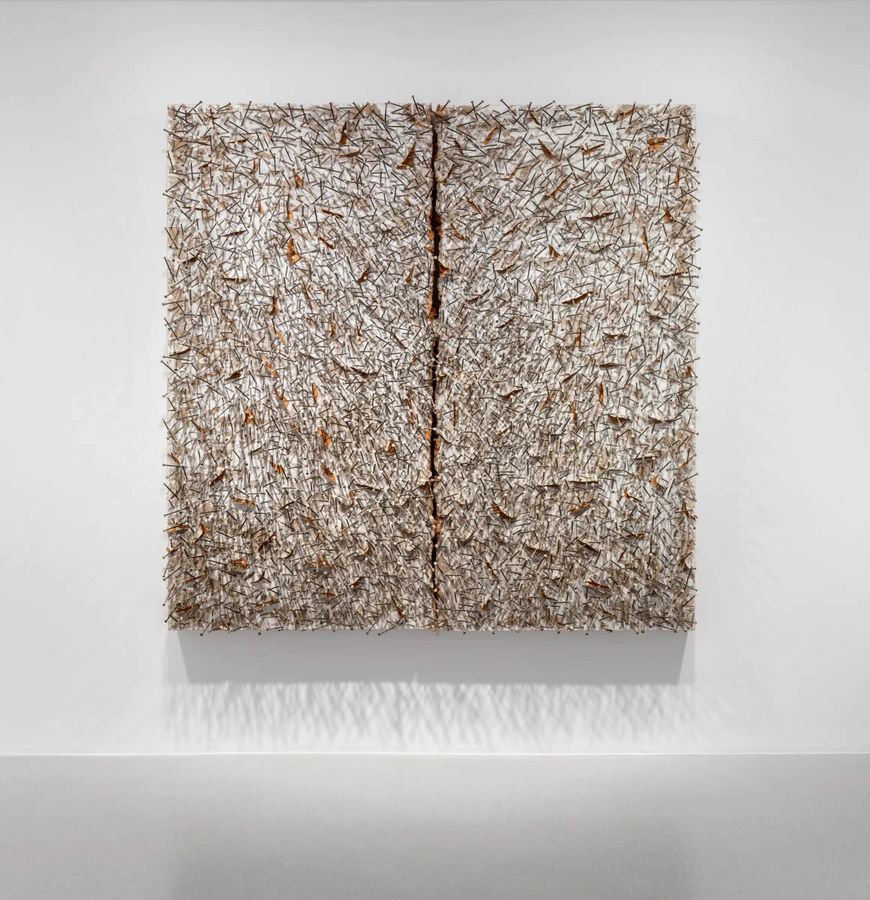
“In the beginning was the nail, which seemed to me to be the ideal object with which to model light and shadow – to make time visible.” – Günther Uecker Verletztes Feld (Wounded Field) at Thaddaeus Ropac Paris Marais presents the 1981 painting of the same name by the German artist Günther Uecker (1930–2025), made in his signature medium: nails. The work is split open with an axe – the earliest known instance of this defining gesture in Uecker’s oeuvre. It is shown alongside a series of 22 painted photographs, born of a collaboration between the Swiss photographer Rolf Schröter and Uecker, which retrace the making of the painting. The surface of Verletztes Feld is a dense, irregular bed of nails. As the light changes, the metal points cast shifting shadows across it like a sundial, measuring not only light and form but also making the passage of time visible. This sense of change and movement grows out of the work Uecker made during his involvement with the ZERO group between 1957 and 1966; as he explained, “what is important to me is variability, which is capable of revealing the beauty of movement to us.” Projecting beyond the canvas, the nails break through the two-dimensional plane and enter the viewer’s space, pointing outward from the artist to the world, from the work to the viewer, and so reversing the usual direction of exchange between them. Each nail is driven into a canvas stretched over a wooden panel that Uecker painted with his bare hands. Working around the areas to be nailed, he traced “vortexes and spirals” in the white paint with his palms and fingers. The austere colour reflects the state in which he worked – free of conscious thought, his body a conduit for direct communication with the material. White is purity, ointment on a wound, “the epitome of light” and a “triumph over darkness”. By splitting the work along its vertical axis with an axe, Uecker created a composition that recalls both Lucio Fontana’s cuts and the spine of an open book. The rupture remains open-ended: at once a laceration and a place of healing through which light might seep, ominous yet meditative. The act is one of destruction but also, inherently, of creation; as Uecker put it, “mountains and childbirth are also immense. Without violence, we would not be able to bring ourselves into being.” Few artists have reflected the issues of their time as consistently as Uecker, from the outset of his career to its end. Deeply engaged with the world, in the 1980s he responded to the growing human threat to the environment and to humanity itself with increasingly irregular, ravaged interventions charged with a new emotional intensity. Using his own body as a medium, he reached across the borders of the picture plane: a portrait of the artist worked over with nails as a chasm tears the canvas apart, the axe opening a wound that he soothes with white paint. The endangerment of humans by humans becomes a universal theme, a shared human experience, with the works caught in a continuous process of violation and connection – a ritual performance intended as a starting point for the viewer’s own sensory experience of being and existence. The 22 accompanying photographs, taken by Schröter in Uecker’s studio, form a chronological record of the artist’s choreographic, almost ritualistic process. Uecker individually overpainted or perforated each print, making every one unique. Usually kept together in a wooden case whose lid is itself a small nail relief, they are displayed alongside Verletztes Feld, the only known painting by the artist with a work of this kind dedicated to the process of its making. Shown together, the photographs become an extension of the painting. Replacing the paintbrush with a range of direct approaches to the canvas – from vehement onslaughts with nails or an axe to the caress of his paint-covered hands – Uecker redefined not only the artwork but the very act of making art. “Emotions transform into gestures, into artistic actions – they become visible and form a field, like cropland, tilled and furrowed, nailed, planted,” he said. For Uecker, the work and the embodied act of its creation, to which the photographs bear witness, were inseparable; he considered his paintings “a poetic concentration of myself”. His wounded field of nails – lush as a crop yet overcast with shadow – becomes a metaphor for the body and for the world we live in.