
New York · 06/11/2026
Lucas Samaras: Boxes and Reconstructions
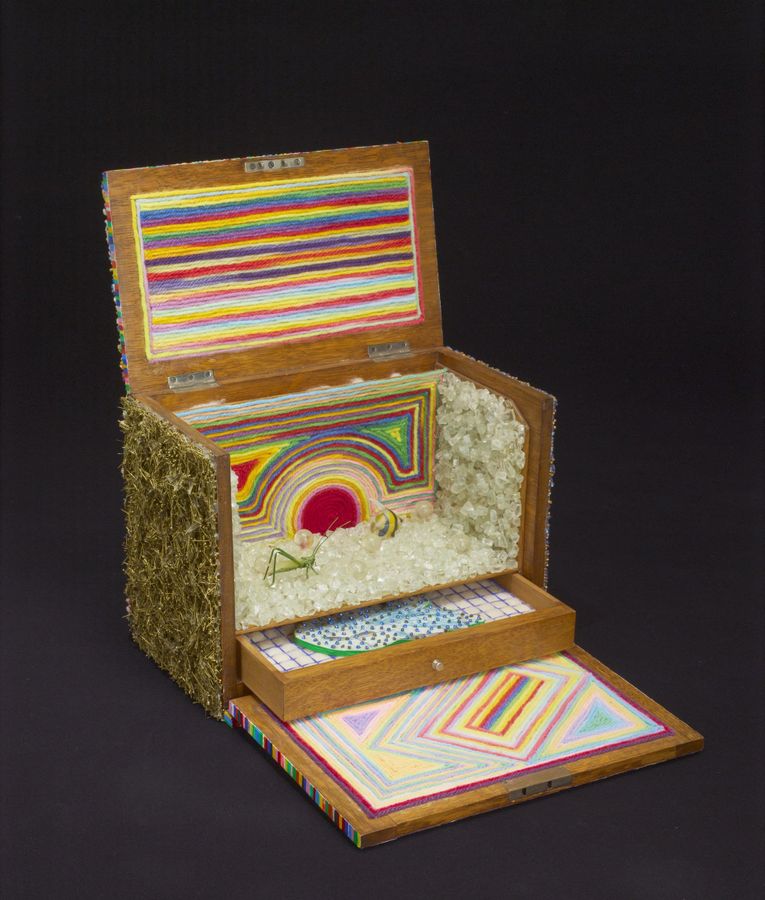
Boxes and Reconstructions unites two pivotal bodies of work by the influential Greek-born American artist Lucas Samaras at Pace's 540 West 25th Street gallery. A selection of his iconic and deeply enigmatic box sculptures, made between the 1960s and the 1980s, is shown together with never-before-exhibited fabric paintings from Reconstructions, a pioneering and little-known series he made in 1979. Over more than seven decades at the leading edge of the avant-garde, Samaras made work that was at once intensely personal and formally inventive. Drawing on his own history—from a childhood lived through the Greek Civil War to his place in the New York avant-garde of the 1950s and 1960s—he moved between sculpture, photography, painting, drawing, and digital art to probe the nature of selfhood and identity. The boxes, the works for which he is best known, reflect his enduring commitment to assemblage as an assertion of the self. Shown in dialogue with the sewn fabric works he called Reconstructions, they reveal his uncanny gift for gathering ordinary materials from the world around him and transforming them into surreal, self-contained environments. Samaras began making rough, assemblage-based sculpture in the late 1950s, while still a student at Rutgers and an active participant in the Happenings in New York. In the long series of interactive mixed-media boxes he started in the early 1960s, he used liquid aluminum and plaster to fix photographs, ephemera, and found objects—cutlery, nails, mirrors, brightly colored yarn, feathers—to structures riddled with compartments, drawers, and hidden interiors. The critic Thomas McEvilley saw this gathering and repurposing of the stuff of life as a kind of self-portraiture: "History's wreckage in World War II, a fact somewhat shrouded from American artists, left [Samaras] not with a search for history but with the theme of the self unsupported by historical mission: the delicacy and courage of selfhood on its own, finding new uses for the random remains of history, constructing a world out of them." Begun in the early 1960s, the box series continued for three decades and ultimately comprised nearly three hundred unique works. The exhibition traces its evolution, from the relatively simple hinged construction of the rectangular Box #5 (1963–1968) to the sinuous yet sinister curves of the Cor-ten steel Stiff Box #14 (1971) and the cosmic Box #133 (1989). "Samaras's assemblage boxes continue their wicked, seductively beautiful ways," wrote Roberta Smith, "only more so, since the artist knits together and patterns color, the ultimate tool of visual seduction, more complexly. [T]he viewer is cast as involuntary voyeur. . . everyday objects and materials take on unexpected lives of their own." Combining elements of sculpture, architecture, and painting, the boxes are among the most evocative and intimate works Samaras made. These objects are placed in conversation with a group of works from the 1979 Reconstructions series, drawn from the artist's personal collection and exhibited here for the first time. Like the boxes, these complex compositions of hand-sewn fabric bring together a multitude of patterns, colors, textures, and shapes in exceptionally lively arrangements. Fabric also carried autobiographical meaning for Samaras. "I had a cousin in Greece who had a dress shop," he told Barbara Rose in 1978. "I would go there in the afternoon and I would cut up some paper. But, if I went to touch the fabric, she would say, 'now watch it, don't touch the fabric.' When I became an adult, or semi-adult, I began using things like pins and wool, and nobody could tell me anymore, don't use them, don't touch them. Even using the fabric, in a sense, is going back to childhood again." The Reconstructions are partly a tribute to the textiles that surrounded Samaras in his youth, yet, like all his work, they resist easy classification. Seen in light of his later experiments with digital art and photography, their jumble of visual information can resemble a distorted signal or a field of pixels. Above all, though, they read as paintings. As the critic Kim Levin wrote, "Samaras's Reconstructions must be seen as paintings, highly sophisticated and completely perverse. Big dazzling abstractions. They are also variegated, witty, improvisational hybrid surfaces that fuse random and disparate materials into a seamless expressive whole. They reconstruct not folk handicraft but modernist art." Resisting art-historical categories, Samaras's work is held together by its sustained attention to the body and the psyche, often through autobiography. Self-depiction, self-examination, and identity drove a practice that, from its beginnings in the early 1960s, extended the Surrealist idiom while marking a radical break from the dominant concerns of Abstract Expressionism and Pop art.