
New York · 13/11/2026
Rothko/Gottlieb: The Surrealist Years
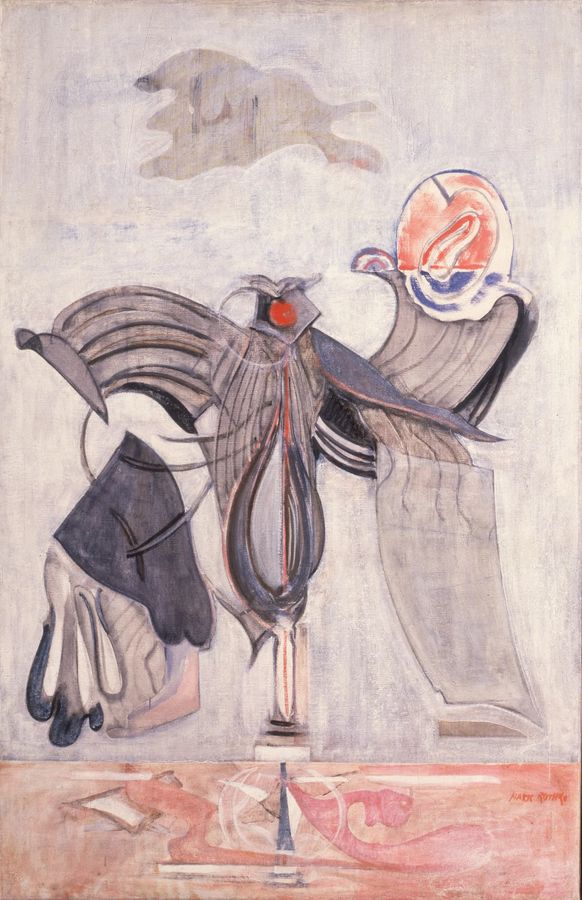
Rothko/Gottlieb: The Surrealist Years brings together paintings and works on paper by two central protagonists of Abstract Expressionism, Mark Rothko and Adolph Gottlieb. Curated by Arne Glimcher as a sequel to Gottlieb/Rothko: The Realist Years, shown at 125 Newbury in 2025, the exhibition gathers works from 1941 to 1951—a decisive decade in which both artists left Realist figuration behind and forged a new language of Surrealist abstraction. Throughout these years Rothko and Gottlieb sustained an unusually close artistic and intellectual exchange, turning together to myth, to automatism, and to the power of the unconscious in search of new ways to picture a world radically reshaped by history. At the heart of the exhibition are works from 1942 to 1946, when the devastation of the Second World War and the Holocaust transformed the material and psychological landscape of Western culture. The war's impact on artists was profound: faith in progress, reason, and classical humanism had been shaken, and artists faced the task of addressing a reality that seemed increasingly beyond the reach of conventional representation. For Rothko and Gottlieb, myth, archaic imagery, and invented signs opened new ways to explore the depths of human experience—a pre-industrial psyche untainted by the sins of modernity. The two had been close friends and artistic allies since the late 1920s. Around 1940 each began to move away from conventional representation, Rothko through mythic and biomorphic imagery and Gottlieb through a vocabulary of pictographic forms. Their paintings of the 1940s share a fascination with symbol and myth and with the possibility of excavating a new visual language from the deep fissures of a common past. Their thinking was shaped by encounters with Picasso, Miró, Klee, and other European modernists, and by the arrival in New York of exiled European Surrealists during the war. Absorbing the key ideas of Surrealism—automatism, myth, dream, and the unconscious—Gottlieb and Rothko made them their own. In 1941 Gottlieb began composing paintings from stylized, simplified figures, animals, and symbols arranged within an irregular grid. The exhibition includes a selection of these Pictographs, among them an early example from 1941. Gottlieb would work in this idiom, as evocative of carved ancient glyphs and runes as of prehistoric cave paintings, for the next decade and into the mid-1950s. Rothko's assault on classicism, meanwhile, took a more organic, biomorphic turn. In Gethsemane (1945), a highlight of the exhibition, he renders the pathos of the biblical account of Christ's betrayal and final hours in a form that is psychologically charged yet entirely abstract. The closeness of their thinking in these years is reflected in two jointly authored statements from 1943. In a letter published in The New York Times on June 13, the artists responded directly to the critic Edward Alden Jewell's dismissal of their work. "We favor the simple expression of complex thought," they wrote, famously calling for subject matter in modern painting that was both "tragic and timeless." That October, in the WNYC radio broadcast "The Portrait and the Modern Artist," they elaborated on the role of myth in opening new possibilities for painting, declaring that "the whole of man's experience becomes his model." The exhibition returns to this moment, when the familiar world had become strange and painting was searching for a new language to confront a reality transformed by war. Across both artists' work, fragments of mythic form hover between the recognizable and the unknown. Rothko and Gottlieb remain bound together in this epic quest, each finding his own way forward. The abstractions that would follow are already latent here—as is the strange, unsettled world from which they emerged. These works foreshadow what was to come, yet they also stand on their own: mysterious, searching, and charged with the uncertainties of their time. Mark Rothko (born 1903 in Dvinsk, Russia; died 1970 in New York), a pioneer of the New York School, is best known for the immense, mesmerizing Color Field paintings he made between 1949 and 1970, which followed his figurative and biomorphic work. His explorations produced a wealth of works on paper and canvas in which layered veils of vibrant pigment and earth tones culminate in luminous, ethereal, soft-edged compositions. Committed to an experimental engagement with process in pursuit of a universal expression, Rothko believed that painting was a deeply psychological and spiritual experience through which the most basic human emotions could be conveyed. Adolph Gottlieb (born 1903 in New York; died 1974 in New York) was a leading figure of the New York School. A champion of abstraction, he made paintings, drawings, prints, sculpture, and tapestries in a visual vocabulary grounded in automatism, primitivism, and Surrealism. He first won wide recognition for his Pictographs, which combine biomorphic abstraction with totemic imagery in compartmentalized compositions. In 1950 he organized the protest against an exhibition at The Metropolitan Museum of Art that earned him and a group of fellow artists the name the Irascibles. Continuing to refine his approach, he went on to develop his Labyrinths, Imaginary Landscapes, and Bursts, works whose painted gestures and abstract forms strike the viewer with immediate, visceral force.