
Dubai · 19/09/2026
The Field of Dreams
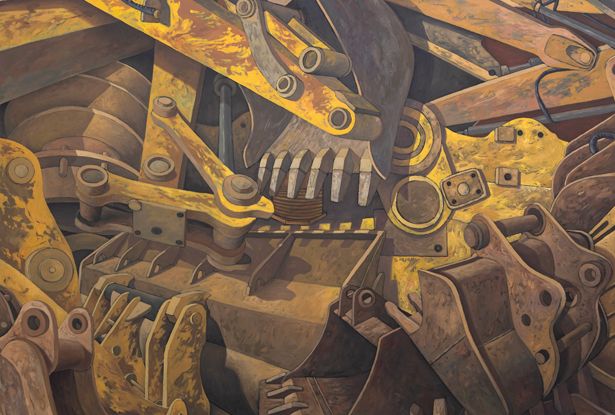
Bashar KhalafLocation: Dubai The Field of Dreams… On the fragile existence across temporalities In our world today, the “anxious artist” stands alone, confronting multiple destinies as his own self appears as a broken machine, spinning restlessly like a swirl in a hopeless attempt to piece together its fragmented parts! The Field of Dreams is an exploration of formations of “steel” in the public space from the perspective of the relationship between the self, the object, and the other. It can be viewed as an interactive space with the fragile reality in which humanity lives. Artist Bashar Khalaf creates an ambiguous dialogue with accumulated “steel” by employing several dry and liquid media. He uses oil colours in two series of artworks: Junk Garden and Protective Shield, charcoal on paper in the series: Alhisbeh Fire, and the plastic acrylic colours that hint to the relationship of all of this with the place, through the series: WeRamallah. In a complex language, Khalaf confronts us with the dilemma of the present, not with the goal of transcending it, but of comprehending and understanding it. In fact, this state of contradictions possesses an exceptional ability to fix our gaze upon the era in which we live, focusing on its most ambiguous aspects. This is the essence of the thinking of a “contemporary” artist who, as Giorgio Agamben describes, “fixes his gaze so firmly upon his era that he doesn’t perceive its light, but its darkness.” The Field of Dreams, or dreams as minefields, is nothing more than the dysfunctional and non-operative dreams of “junk”, that remind us with their dynamic state, in which their multiplicity and dependence on modern structures of unbridled capitalism and the transformative domination of life cannot be intercepted. Dreaming energy grants these bygone “steel” structures, bulldozers, vehicles, and surveillance cameras, an immense power for self-reinvention and the regeneration of their own symbols of understanding the world. We witness the shattered machine losing itself in the chaos of its struggle with destiny, much like a war where power crumbles before the energy of scrap metal in its unveiling and portraying the true face of the world. It confronts the machine with its own existence, giving it a tragic form, and engaging deeply with the cycle of time to reposition itself differently in relation to the world and others. Bashar Khalaf emphasises his paradoxical dialogue by depicting “garbage bins” in Protective Shield, highlighting their multifaceted role during the First Intifada, when they were used to block streets, stopping the advancement of the colonial-settler war machine in Palestinian cities, and providing shelter from bullets during demonstrations. In contrast, the colonial system used steel barrels to seal off the entrances to villages and camps after filling them with cement, aiming to besiege and isolate Palestinians. Between these two situations, Khalaf takes us to such a crumbling form, in the centre of a swirl, deliberately merging “steel” within its own parts and redundant images, from the perspective of the personal transformation accumulated in his past images. In a similar vein, the scene of devastation in the Alhisbeh Fire series confronts us artistically and thematically with a stark composition. The shops, gutted by the Israeli occupation, are collapsing from within; nothing remains of them but their blackened doors, as the steel has melted, leaving behind cracks, gaps, and the lingering memories of ordinary people. A profound sense of sadness stirs deep within us here, as all of this unfolds amidst the fragile relationships, artist Bashar Khalaf has sought to build through his WeRamallah series. It is a fractured Ramallah, home to Junk Garden and haunted by memories of Protective Shield, while stands as a witness to Alhisbeh Fire, as a metaphor for the daily fires ignited by settler colonialism in Palestine. Khalaf gives expression to this relational fragility through plastic hearts pierced by bullets. The Field of Dreams poses profound questions about whether humanity will adopt fundamentally different choices from the contemporary process of hegemony. Perhaps artist Bashar Khalaf is restoring the power of critique through his project by capturing the rays of darkness that inhabit existing ideas and the questions they constitute. Jad Izzat Al-Ghazawi PRESS RELEASE