
Exhibo Editorial
European heatwave lays bare museums' climate adaptation gap
As temperatures soar across the continent, a stark divide has emerged between institutions that can keep cool and those left sweating
A continent divided by climate control
On 20 June, Frankfurt's Deutsches Architekturmuseum opened what may be the most timely exhibition in recent memory. Titled TOO HOT: Scorching Cities, New Ideas (running until 7 February 2027), the show examines the growing dilemma facing urban architects: how to create cool spaces without sending energy costs spiralling.
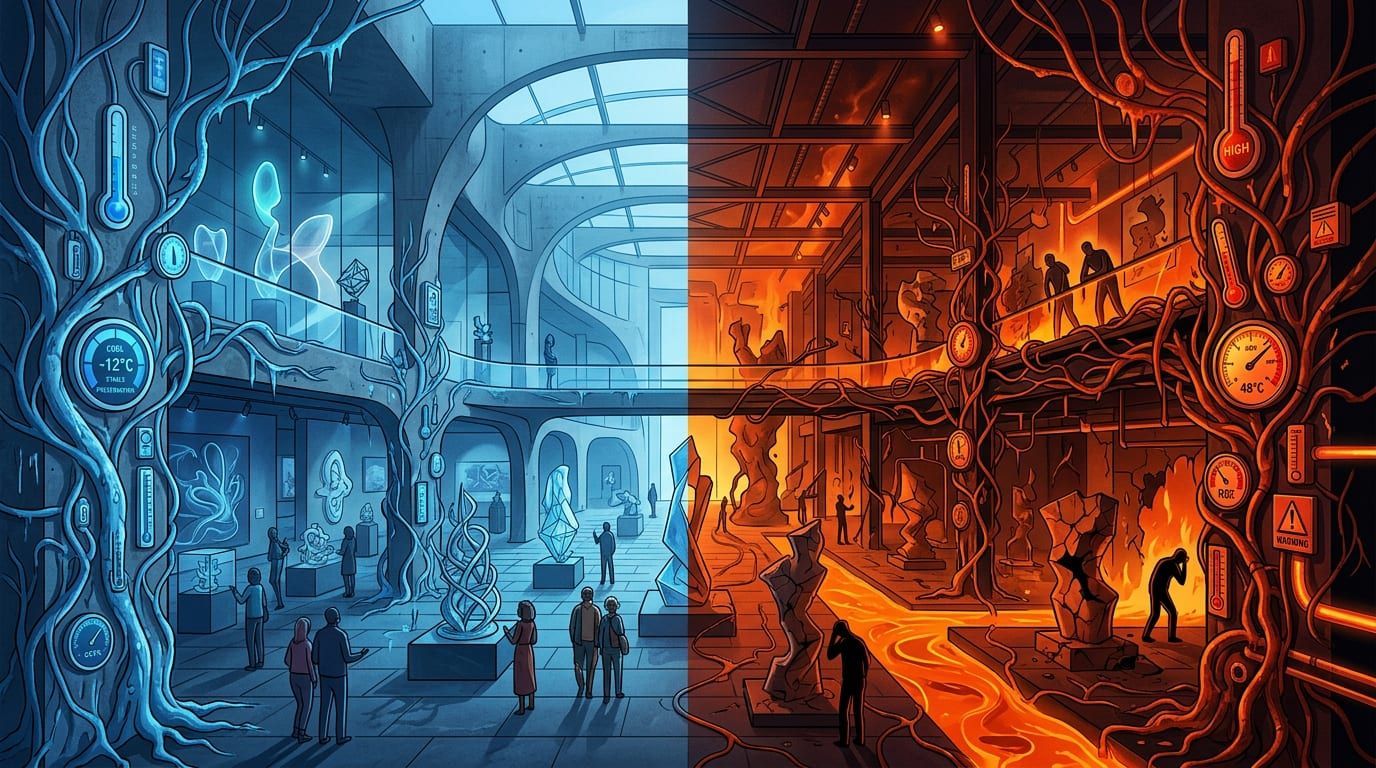
Few building types embody this tension more starkly than Europe's museums. With thermometers across western and central Europe registering in the mid-to-high 30s Celsius, a sharp divide has emerged between those with functioning climate control and those without.
Institutions with air conditioning have become integral to municipal heat-response strategies. Staatsgalerie Stuttgart posted gleefully on Instagram: "38C in the shade? We have air con in our collection rooms!" In Bordeaux, Nantes, Lyon and Strasbourg, local authorities have waived admission fees or kept museums open on their usual closing days, designating them as "islands of freshness" within broader urban heat-management plans.
Those without such systems, however, are simply sweating alongside everyone else. In Brussels, Amsterdam and Geneva, smaller venues have shut galleries or restricted access, citing interior temperatures above 30C. Paris's Musée Carnavalet has closed everything except its temporary exhibition spaces — the only air-conditioned rooms in the building. The City of Paris press office, which oversees both the museum and the archaeological Crypt of the le de la Cité, told The Art Newspaper that no one was available for comment because "we too are in crisis management."
Why the split?
Museum directors and heritage specialists point to building typology, age and structural flexibility as contributing factors, alongside gaps in knowledge and data. But cost is the dominant obstacle. The Musée du Louvre announced on Tuesday that it would close two hours early from Wednesday to Saturday, citing deteriorating conditions for both visitors and staff during.
Ann Bourgès, a senior conservation scientist at the French ministry of culture's Centre for Research and Restoration of France's Museums and secretary general of the French chapter of ICOMOS, argues that many European institutions occupy structures "conceived for a climate that no longer exists.
" She says: "We are not prepared for these events, be it in terms of welcoming visitors or ensuring museum staff are comfortable, or indeed for the conservation of works."
The Louvre, she notes, has begun mapping the climatic conditions of its various galleries and is participating in the European research initiative JPI Refresh, which studies how climate change affects artwork conservation. "We're doing the right thing, but are being taken over by events," she adds.
Aqua Sanfelice di Monteforte, managing director for fine art at insurance broker Bridge Specialty International, agrees that no European region is fully prepared. "Larger institutions with dedicated conservation teams and investment capacity are generally better equipped. However, many smaller or historic institutions are still catching up, especially as temperature extremes are becoming more frequent and less predictable."
Resources, not age, determine resilience
The curatorial team behind the Frankfurt exhibition — Mathias Schnell, Jonas Malzahn, Katharina Böttger, and deputy director Andrea Jürges — stress that cost is the primary barrier. "Air conditioning is expensive and often in tension with sustainability goals," they note. Preparedness, they argue, depends less on a building's age than on the resources and adaptation strategies invested in it.
Research supports this view. A 2022 survey by the Network of European Museum Organisations, covering 578 institutions across 38 countries, found that while climate change and sustainability were widely acknowledged as important strategic priorities, fewer than one in ten had analysed regional climate challenges in detail. Only three in ten had assessed the specific climate impacts their own institution was likely to face. The principal reason, alongside a lack of specialist knowledge, was a lack of funds. More than half of respondents reported having no climate-friendly construction measures in place whatsoever.
Museums mentioned
Related reading

Ana Vaz: The Camera is the Body at Mudam Luxembourg
Mudam stages the inaugural major institutional survey of the Brazilian filmmaker's interdisciplinary practice
An immersive exhibition reimagines cinematic perception through embodied filmmaking, ecological inquiry, and postcolonial critique.

Lovis Corinth: Then Came Berlin!
How a mid-life relocation ignited a German modernist revolution
An expansive survey at the Berlinische Galerie traces how Lovis Corinth's 1901 move transformed him into a cornerstone of early twentieth-century avant-garde practice.

Bridging Japanese Craftsmanship and Contemporary Design
How international makers engage with Tokai's industrial heritage at the V&A
An exploration of how global designers collaborate with Japanese artisans to fuse ancestral techniques with modern conceptual frameworks.