
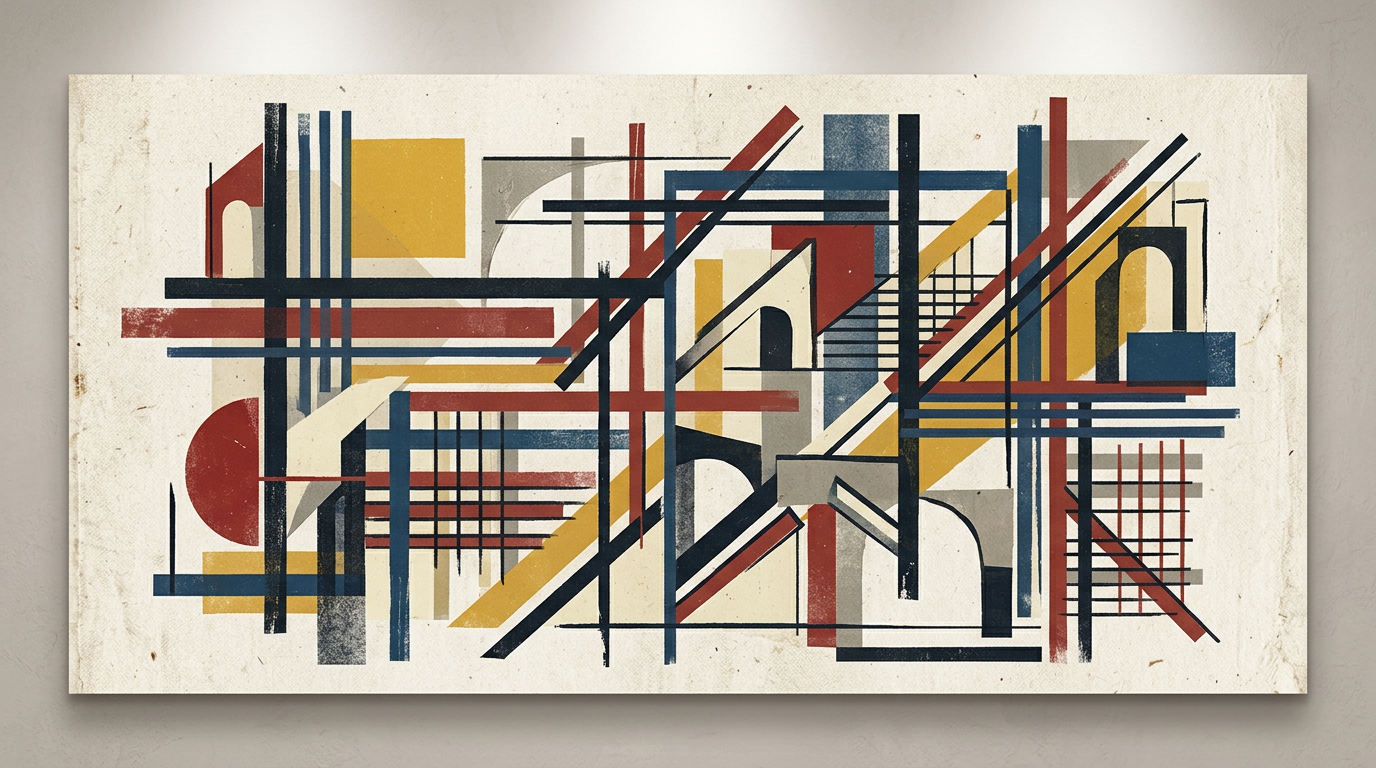
London · United Kingdom
Marlow Moss Steps Out of Mondrian's Shadow in New London Retrospective
The pioneering Constructivist receives her first major UK showcase since the 1970s.
Reclaiming a Modernist Vision
For more than fifty years, British audiences have been without a dedicated commercial gallery presentation of Marlow Moss (1889–1958). That omission finally concludes today at Ward Moretti, located on Duke Street in St James's. Running until late October, the survey brings together roughly thirty pieces across painting, drawing, and sculpture, offering a comprehensive view of a practitioner who consistently operated ahead of her era. Despite growing scholarly interest, the artist remains comparatively obscure, though institutional acquisitions and market activity are rapidly altering that landscape.
From Cornwall to the Parisian Avant-Garde
Born Marjorie Jewel Moss to a textile industrialist family, she trained at the Slade before relocating to Cornwall in 1919. It was during this period that she radically reinvented herself, adopting a shorter name, cutting her hair, and embracing masculine equestrian attire. By 1927, having cycled between southern England and the capital, she settled in Paris, the epicentre of interwar experimentation. Enrolling at the Académie Moderne, she studied alongside Fernand Léger and formed a lasting bond with Georges Vantongerloo, a founding figure of De Stijl who would later champion her practice. During this same window, she met Antoinette Nijhoff at the Café de Flore; the Dutch writer became her enduring companion.
The Mondrian Connection
Through Nijhoff, Moss encountered Piet Mondrian shortly after arriving in France. Their studios stood adjacent, and over the following decade they developed a mutual respect centred on Neoplastic principles. Historical narratives frequently positioned the older Dutchman as the primary influence, yet contemporary research indicates Moss exerted considerable creative pressure on him. Specifically, she introduced the concept of parallel linear divisions around 1930. Correspondence from 1932 reveals Moss explaining how multiple intersecting strokes generate spatial rhythm, transforming rigid grids into living structures. Although Mondrian initially struggled to grasp her theory, he subsequently integrated similar techniques into his canvases throughout the 1930s. Art historians note that Vantongerloo repeatedly urged Mondrian to acknowledge his collaborator's contribution, but such recognition never materialised publicly, leading to a prolonged professional rift before relations normalised in 1936.
Scarcity and Scholarly Recovery
Contemporary accounts often dismissed both women with condescension, reducing their radical lifestyles to gossip. Following the outbreak of conflict in 1940, Moss evacuated to Cornwall aboard the final civilian vessel departing continental Europe. The wartime devastation of her Normandy studio, combined with her own rigorous standards and painstaking layering technique, meant that only a fraction of her total output survives today. Roughly sixty paintings remain extant, with many held within public collections or private hands.
Curator Emma Ward notes the logistical challenge of mounting such a survey given the limited number of surviving objects. Nevertheless, recent decades have witnessed a steady rehabilitation of her reputation. Major institutions including the Rijksmuseum, the National Gallery of Victoria, and the Centre Pompidou have actively acquired her paintings. Earlier this year, Berlin's Georg Kolbe Museum hosted a dedicated retrospective, signalling broad European recognition.
Market Resurgence
Commercial valuations have mirrored this institutional shift. Where works once traded comfortably below £200,000, recent sales demonstrate dramatic appreciation. A 1953 composition recently realised £1.1 million at Sotheby's London, shattering previous benchmarks and underscoring renewed collector confidence. The current show features that record-breaking piece alongside a marble infinity loop crafted for Nijhoff after their postwar reunion. This sculptural object had rested on the writer's grave until conservation authorities intervened last year, prompting its removal by the estate. Alongside loaned masterpieces, additional paintings are available through the gallery, spanning prices from twenty thousand to two and a half million pounds.
Related reading
The Case for Ring-Fencing the UK's Proposed Tourist Levy for Cultural Institutions
Why cultural advocates insist the overnight visitor surcharge must directly fund galleries and museums
Senior museum directors and policy experts argue that revenue from the proposed tourist fee should be legally protected for the arts sector.
Baltic Curators Begin London Fellowships at Hayward & Camden
Extended residencies embed Latvian and Lithuanian practitioners into UK institutions
Two early-career specialists start permanent placements at the Hayward Gallery and Camden Art Centre through the Upė Foundation scheme.

Cultural Crossroads: Ancient Textiles, Conflict Zones, and Public Sculptures
Curatorial insights, heritage conservation alerts, and contemporary public art
From a rare Norman textile loan to the British Museum, the urgent preservation of Iranian archaeological sites, and Tschabalala Self's latest Fourth Plinth commission.