
Lisbon · Portugal
Lisbon's Gulbenkian Museum Revives Its 1960s Vision After Extensive Refurbishment
A €7.8m renovation restores the Portuguese institution to its mid-century modern roots, reuniting architecture, art and landscape
A Return to Origins
After eighteen months of closure, Lisbon's Museu Calouste Gulbenkian has reopened its doors, marking the 70th anniversary of the foundation that bears its founder's name. The €7.8m refurbishment addresses essential infrastructure upgrades while deliberately steering the museum back towards its original 1969 character, according to Xavier Salomon, who assumed directorship midway through the project.
The institution houses the remarkable collection of Calouste Gulbenkian, the Armenian-born oil magnate who earned the nickname "Mr Five Percent" through his dealings in Middle Eastern petroleum. When he died in 1955, his personal holdings numbered over 6,000 objects spanning coins, rare manuscripts, Renaissance tapestries, Islamic ceramics and glass, and 18th-century French decorative arts. His 1930 acquisitions from the Hermitage alone included works by Rubens and Rembrandt.
Architecture as Curator
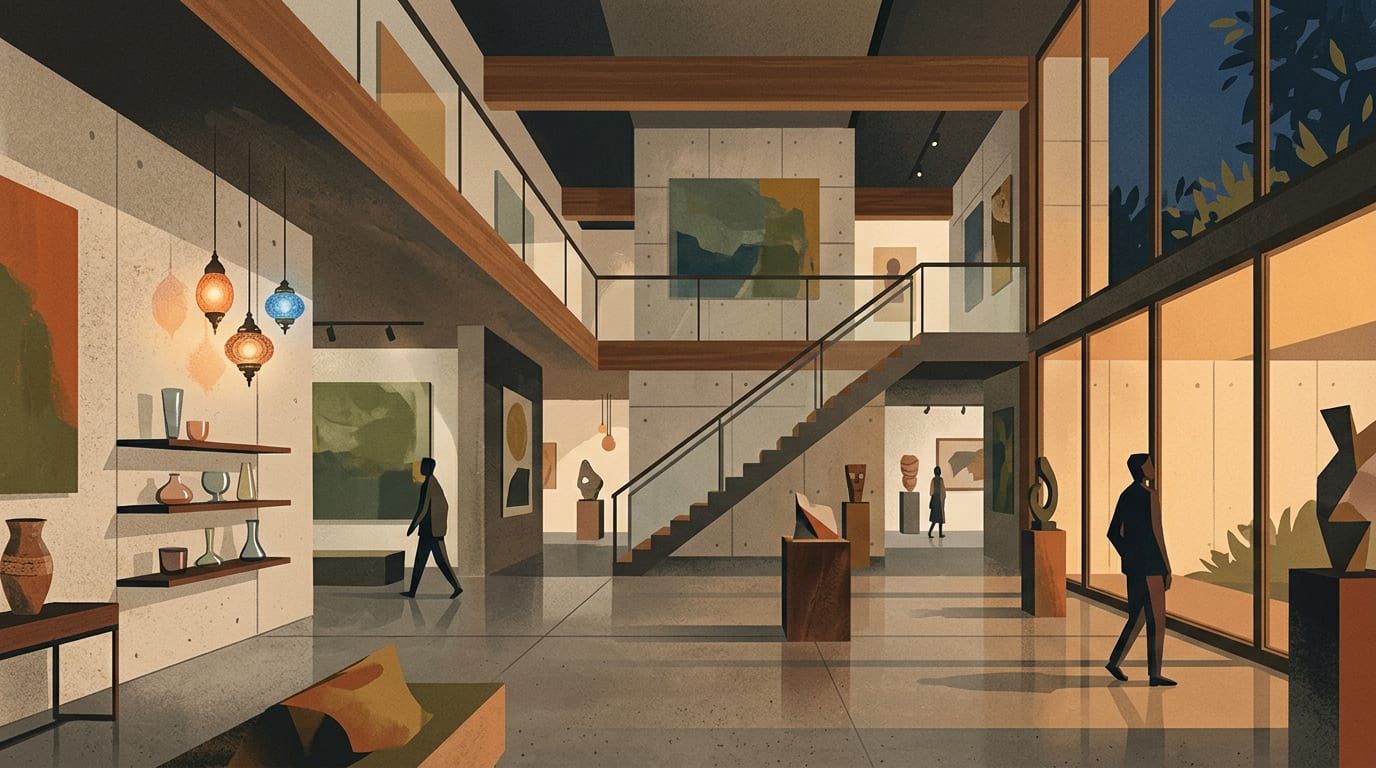
The museum's 1969 building emerged from a collaboration between Portuguese architects Alberto Pessoa, Pedro Cid and Ruy Jervis d'Athouguia, with input from British architect Leslie Martin and Italian designer Franco Albini. The single-storey structure employs wood, granite, marble and raw concrete in a restrained palette that reflects both Brutalist principles and Japanese design sensibilities. Large windows originally framed views across the surrounding parkland, while internal courtyards brought nature directly into the visitor experience.
Over subsequent decades, practical modifications and evolving curatorial approaches gradually obscured this vision. Showcase designs were altered, silk linings replaced with painted surfaces, and sightlines between galleries and the landscape were compromised. The moss-green carpets of the European galleries disappeared beneath varnished boards.
Restoring the Dialogue
Working with architects Teresa Nunes da Ponte and Frédéric Ladonne, Salomon has reinstated the building's architectural integrity whilst incorporating modern museum standards. Anti-reflective glass and LED lighting now illuminate the collections, though the new lighting system deliberately recreates the amber glow of the 1960s. In the Islamic art galleries, 14th-century Mamluk mosque lamps have been returned to individual vitrines, while the Asia wing features a redesigned zigzag display case with multiple access points.
A former private study has been converted into a new numismatic cabinet, providing dedicated space for the coin collection. The Assyrian winged-guardian relief, freshly conserved, now occupies a more prominent position. Perhaps most striking is the transformation of the René Lalique gallery, where silk hangings create a dialogue between Art Nouveau and Deco glasswork and paintings by Edward Burne-Jones and John Singer Sargent.
The Pure Gallery
In keeping with 1969 principles, interpretive labels remain concise and multimedia screens are entirely absent. "They're distracting, and in architecturally pure buildings like ours, they just look terrible," Salomon observes. This approach reflects his experience moving the Frick Collection's holdings to Marcel Breuer's modernist building in New York, where he first encountered the Gulbenkian Museum's integration of art, architecture and natural environment.
The renovation ultimately restores what Salomon describes as the museum's "unique relationship between art, architecture and nature" – a synthesis that had been gradually eroded but is now once again the defining characteristic of this remarkable Portuguese institution.
Related reading
A Rare Market Appearance: Hilma af Klint's Geometric Masterwork Heads to Stockholm
A tightly guarded abstract canvas enters the secondary market, challenging established price benchmarks and highlighting sustained institutional momentum.
A Marketing Mismatch Over Impressionist Iconography
Why a Eurostar campaign overlooks a major London loan
Young Dealers Reshape the Historical Art Market
How a new generation is navigating high costs, family legacies, and shifting aesthetics in the Old Masters sector