
Valparaiso · Chile
St Paul's Cathedral Valparaiso Becomes Museum
Destino Valparaíso takes over the historic Anglican church to highlight British immigration legacy
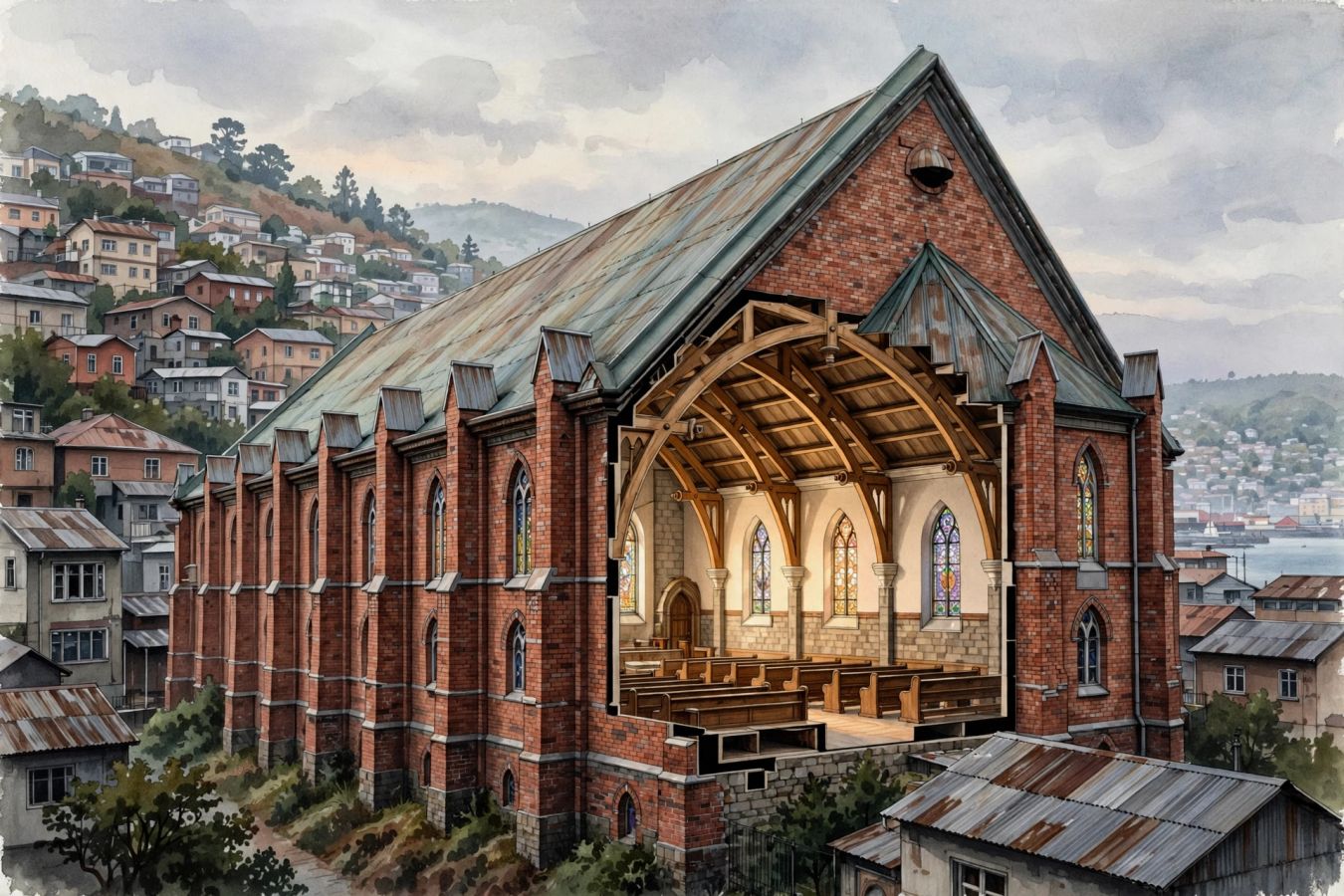
Valparaiso's St Paul's Cathedral is set to become Chile's first Anglican museum. The agreement with Destino Valparaíso takes effect on 30 November. A 50-year lease transfers management of the historic building to the cultural foundation. Restoration work begins immediately. Roof repairs, floor fixes, and stained-glass conservation will take at least a year.
The cathedral stands as proof of British engineering in South America. William Henry Lloyd designed the Neo-Gothic structure after arriving to build the Valparaíso-Santiago railway. Inaugurated in 1858, it emerged during a period of strict Catholic restrictions. So, the design remains discreet. No spire. No cross. No bell tower. Small windows punctuate the walls. The single nave occupies an entire city block.
Lloyd employed advanced techniques for the era. Laminated Oregon pine beams form the ceiling arches, secured with nails and screws. Morris & Co produced one of the stained-glass windows. The organ arrived from England in 1902. Forster and Andrews built the massive instrument. An earthquake damaged it four years later. Repairs followed in 1910. Today, the Queen Victoria Memorial Organ hosts Sunday concerts.
Eduardo Dib Maluk leads Destino Valparaíso. His family purchased the neighbouring former German School in 2016. That building now houses the Immigrant Museum. It opened last year. Unesco declared the area a World Heritage Site in 2003. The museum has since become the most visited site in the district. It tells stories of British, German, Italian, Spanish, French, and Arab immigrants. A recent addition explores sports introduced by newcomers. Rugby. Cricket. Football. Polo. Tennis. Cycling.
Dib plans to incorporate technology into the new museum spaces. He insists this will not be an extension of the existing museum. Instead, it will highlight milestones achieved by the British community. They shaped Valparaiso until the twentieth century. The city was a technological centre. It hosted Chile's first bank. Its first observatory. Its first stock exchange.
The British community largely migrated to Viña del Mar or Santiago over time. Funding for St Paul's dwindled. Lynn Gray sits on the management board. Earthquakes require constant maintenance. She notes that keeping the heritage alive is reassuring. Services will continue. Pastor ordinations. Weddings. Remembrance Service in November.
The church was one of the first buildings on the hill where British and German immigrants settled after independence from Spain in 1818. It served as a meeting point for seamen, merchants, shipbuilders, musicians, artists, and engineers during the nineteenth and early twentieth centuries. Now, it transitions from a place of worship alone to a dual-purpose institution. Preservation meets public history.
Related reading

Emily Carr and E.J. Hughes drive Heffel's Toronto autumn sales
Strong collector demand pushes Canadian masters to new heights at the Yorkville auction house
A Quiet Reattribution at the Frick Collection
How material science corrected a century-long catalogue error

Lotus L. Kang Takes 2026 Sobey Art Award Grand Prize
Inside the jury deliberations, prize distribution, and upcoming exhibition at the National Gallery of Canada