
Luxembourg · Luxembourg
Ana Vaz: The Camera is the Body at Mudam Luxembourg
Mudam stages the inaugural major institutional survey of the Brazilian filmmaker's interdisciplinary practice
Reconfiguring the Cinematic Gaze
Mudam Luxembourg has announced its first substantial institutional presentation dedicated to Ana Vaz. Born in Brasília in 1986, the Brazilian creator has spent more than a decade and a half constructing work that refuses disciplinary confinement. Her practice weaves together moving image, sculpture, and archival research while maintaining sustained conversations with ecological theory, anthropological frameworks, and political philosophy. Across her output, recurring preoccupations emerge: the persistent afterlife of colonial infrastructure, ecological degradation, and the complex ways these forces reshape human, non-human, and even spectral communities. Rather than documenting landscapes passively, Vaz focuses on residual marks, suppressed narratives, and the adaptive strategies that flourish within damaged environments.
Central to her methodology is a deliberate subversion of traditional observational filmmaking. Instead of treating the lens as a tool for domination or extraction, she cultivates what she terms an embodied approach to shooting. This framework prioritises physical presence, affective resonance, and mutual exchange between maker, subject, and location. The resulting aesthetic rejects straightforward representation in favour of relational encounters.
Spatial Montage and Curatorial Architecture
Running from 13 November 2026 until 2 May 2027, the show transforms Mudam's architectural volumes into an active component of the viewing experience. The layout operates as a spatial montage where audio, imagery, and vocal recordings intersect rather than follow linear progression. A central hub functions as an agora, designed alongside São Paulo studio a.ferrari.arquitetura and curated by Fernanda Brenner. This area will host performances, gatherings, and collaborative events led by local groups and frequent collaborators, underscoring the inherently communal nature of Vaz's production methods. Adjacent to this gathering space, a continuously developing fanzine co-published with Nuno da Luz materialises as a living archive, further destabilising conventional exhibition formats.
Selected Works and Material Experiments
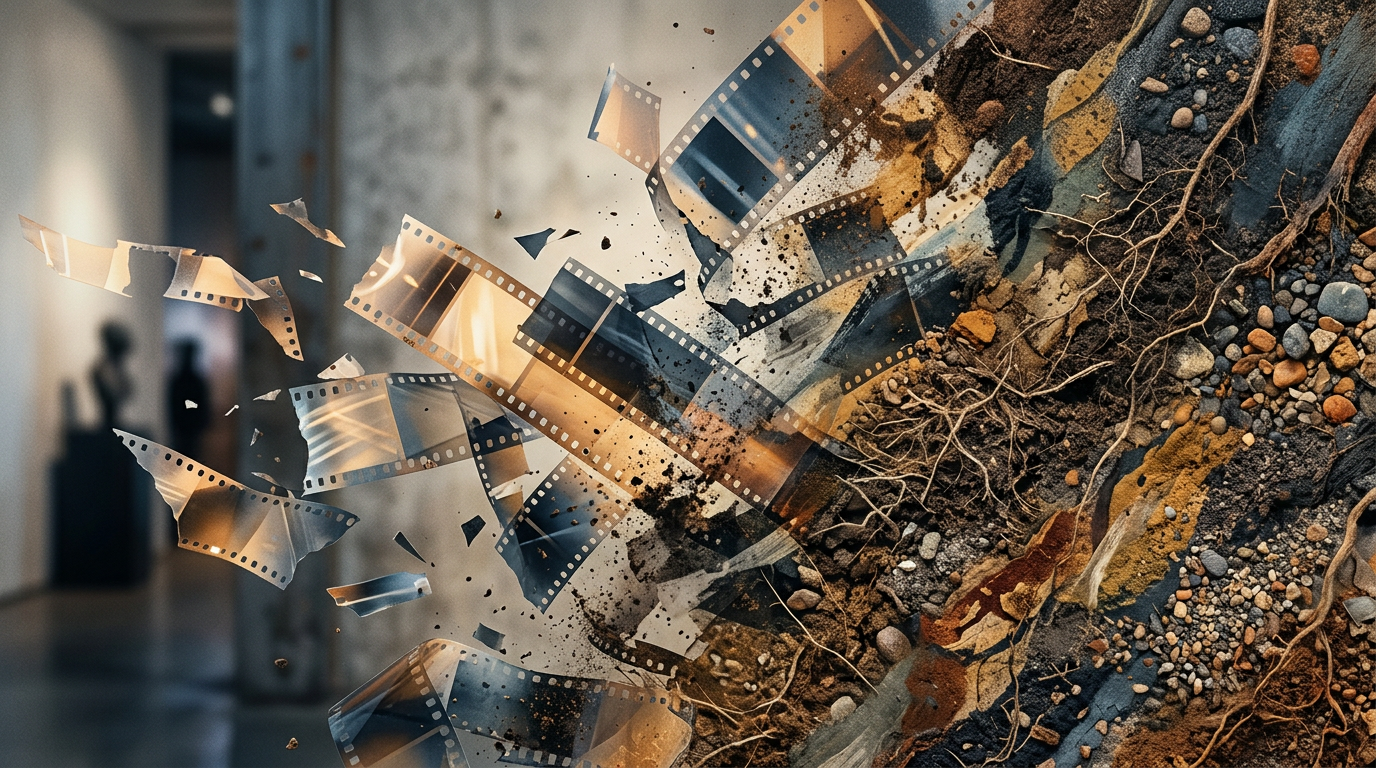
The presentation highlights É Noite na América (2022), a triptych shot at the Brasília Zoo using expired 16mm stock and day-for-night techniques. The piece examines urban encroachment upon wildlife habitats, layering divergent viewpoints to address species displacement. Other installations probe Brazil's stratified histories and extractive economies. Apiyemiyekî? (2019) and Terra preta (2025) engage directly with colonial remnants, with the latter employing a cameraless technique: unexposed celluloid was interred in terra preta, a nutrient-rich ancient Amazonian soil. This method yields what might be described as a cinema of shadows, positioning the ground itself as both creator and subject.
A dedicated gallery surveys the Meteoro cycle (2023–2026). The newest entry, Météore: Nous avons renoncé au Soleil (2026), premiered specifically for this venue. Delivered as dual projections, the quartet treats Paris, Porto, and Rome as phantom metropolises haunted by imperial histories and uncertain trajectories.
Public Programme and Publication
Coordinated by Mudam's Publics and Artistic Departments, the accompanying schedule features seminars, listening workshops, textual engagements, and live events. Notably, the Philharmonie Luxembourg will stage a reconstruction of Sinfonia do fogo (1985/2001), composed by Guilherme Vaz, a foundational figure in Brazilian conceptual and sound art. Alongside the exhibition, a comprehensive monograph edited by Brenner appears through Mudam and JRP|Editions, marking the first book-length study of her oeuvre. Christophe Gallois serves as lead curator, supported by Adèle Wester and Léa Kelsen, with institutional backing provided by the Calouste Gulbenkian Foundation's French delegation.
Further reading: For additional context on this presentation, visit the official announcement at https://www.e-flux.com/announcements/6785620.
Related reading

Christine Sun Kim's FOR EVER at Mudam Luxembourg: A Monument to Deaf Resilience
The American artist's site-specific commission explores sound, language and Deaf culture through sculptural canvases and immersive soundscape
Christine Sun Kim presents FOR EVER at Mudam Luxembourg, a major new commission responding to the museum's Pavilion gallery architecture. The exhibition features four sculptural canvases and a collaborative soundscape examining the endurance of Deaf culture.
Curating Tomorrow's Archive: Hamburger Kunsthalle Seeks Contemporary Collections Lead
A new permanent appointment will steer the museum's post-1960 holdings across paper, photography, and media formats.
The Hamburger Kunsthalle is inviting applications for a senior curatorial position focused on contemporary acquisitions, exhibition strategy, and digital collection management. Applications close October 2026 for a January 2027 start.
Whilst We Are Savages: Colonial Constructs and Atlantic Dialogues
A critical survey at TEA Tenerife exploring how colonial frameworks shaped identity, territory, and knowledge across Europe, Africa, and Latin America.